Przejdź do treści

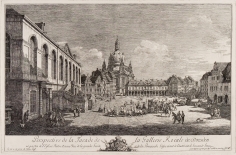
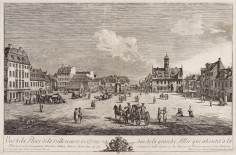
View of the Place de la Grande Garde in Dresden

author of the engraving: Bellotto, Bernardo (1721-1780)

author of the original: Bellotto, Bernardo (1721-1780)

date: 1750

place of creation: Dresden (Germany)

object type: print

material: paper

technique: etching

dimensions: plate imprint H 545 x W 840; sheet 690 x 975 mm

signature:
right bottom corner: peint dessiné et gravé par Ber:rd Bellotto dit Canaletto Pen.re R: le / 1750
inscription:
[inscription divided by a coat of arms]: Perspective de la Place de / la grande Garde aiant d’un / côté le Gewandt. Haus, d’un autre l’Eglise. / Nôtre Dame, vers les Ecuries de S. M.;
left bottom corner: La vue a été lirée de la Moritz-Strasse.
  • Allgemeines Künstler-Lexikon. Die bildenden Künstler aller Zeiten und Völker, München / Leipzig 1997, s. 95 (cykl)
  • Andresen, Andreas, Wessely, Joseph Eduard, Handbuch für Kupferstichsammler oder Lexikon der Kupferstecher, Maler, Radirer und Formschneider aller Länder und Schulen nach Massgabe ihrer geschaetztesten Blaetter u. Werke, t. 1-2, Leipzig 1870-1873, t. 1, s. 225, poz. 2 (cykl)
  • Bernardo Bellotto. W 300. rocznicę urodzin malarza, red. Magdalena Królikiewicz, Artur Badach, Warszawa 2022, kat. nr 25 a, s. 176-178
  • Fritsche, Hellmuth Allwill, Bernardo Belotto genannt Canaletto, Burg 1936, s. 144, poz. VR 15
  • Heinz, Günther, Verzeichnis der Radierungen, [w:] Bernardo Bellotto genannt Canaletto. Ausstellung unter der Leitung von: Staatliche Kunstsammlung Dresden, Nationalmuseum Warschau, Kunsthistorisches Museum Wien, Wien 1965, s. 91, poz. 167
  • Le Blanc, Charles, Manuel de l'amateur d'estampes, t. 1-4, Paris 1854-1890, t. 1, s. 264, poz. 10
  • Manikowska, Ewa, Bernardo Bellotto i jego drezdeński apartament. O tożsamości społecznej i artystycznej weneckiego wedutysty, Warszawa 2014, s. 245-251 (cykl)
  • Meyer, Rudolph, Die beiden Canaletto – Antonio Canale und Bernardo Belotto, Dresden 1878, s. 46, poz. 15
  • Nagler, Georg Kaspar, Neues allgemeines Künstler-Lexicon oder Nachrichten von dem Leben und den Werken der Maler, Bildhauer, Baumeister, Kupferstecher etc., t. 1-22, München 1835-1852, t. 1, s. 395 (cykl)
  • Allgemeines Lexikon der bildenden Künstler von der Antike bis zur Gegenwart, red. Ulrich Thieme, Felix Becker, t. V, Leipzig 1911, s. 489 (cykl)
  • Vesme, Alexandre de, Le Peintre-graveur Italien. Ouvrage Faisant Suite au Peintre-graveur de Bartsch, Milan 1906, s. 496, poz. 15
  • Żak, Izabela, Dawna grafika włoska, t. 1-2, Wrocław 2017, s. 75, poz. 103
not on display

National Museum in Wrocław Department of Prints 16th–19th c.

inventory number: MNWr VII-2157

copyrights to object: PUBLIC DOMAIN
Download

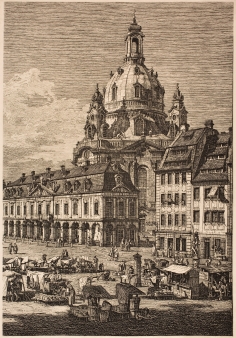
The print represents Dresden’s busy Place de la Grande Garde, today’s Neumarkt (New Market Square), viewed from Moritzstraße. Like in other prints from the Views of Dresden series, the monumental architecture of Saxony’s capital provides a monumental and somewhat theatrical backdrop for scenes from everyday life. In the foreground, on the right, there are stalls selling various goods: wicker baskets, lengths of cloth, clay pots, etc. On the left, a crowd of onlookers watches an itinerant troop of artists, entertained by a clown performing to musical accompaniment. An elegant couple and a nanny with a little girl in her charge are walking along the Cloth Hall, shown in the middle ground on the left, with a sundial installed on the building’s façade. The square is also busy with traffic of stately carriages, elegant coaches and utilitarian carts. On the right rises the Baroque dome of the Frauenkirche (St Mary’s Church), built in 1726-1743 to a design by Georg Bähr. A guardhouse shown in front of the church will suffer serious damage during the Seven Years War and will eventually be demolished in 1766. Close to the composition’s right edge, two townhouses in Pirnaischen Gasse are partially visible and in front of them one of the oldest fountains in the city. Originally, it was installed in the square’s different section and was surmounted by the figure of Eirene, goddess of peace: hence its first name – the Fountain of Peace. After the Battle of Vienna in 1683, in which Saxon troops were engaged as part of the victorious allied forces prevailing over the Turkish army threatening Europe, the figure was replaced with the statue of Victory (interpreted by some as the Roman goddess of war Bellona). From then on, it became known as the Fountain of Victory or Turkish Fountain.

keywords: Baroque  |  Dresden (Germany)  |  fountain  |  Frauenkirche (Dresden)  |  German graphics  |  graphic reproductions  |  Italian graphics  |  town  |  market square  |  German art  |  veduta  |  views of Germany

Related objects (12):

PL | EN

Privacy Settings (cookies)

This website uses cookies so that our service can work better. For more information and to personalise your preferences, click ‘Settings’. You can change your preferences at any time and you can also withdraw your consent to the use of cookies on the site below.
Privacy policy (the link will open in a new window)
*with the exception of technical cookies
By sliding the toggle to the right, you activate a specific consent. By sliding the toggle to the left, you deactivate that consent.