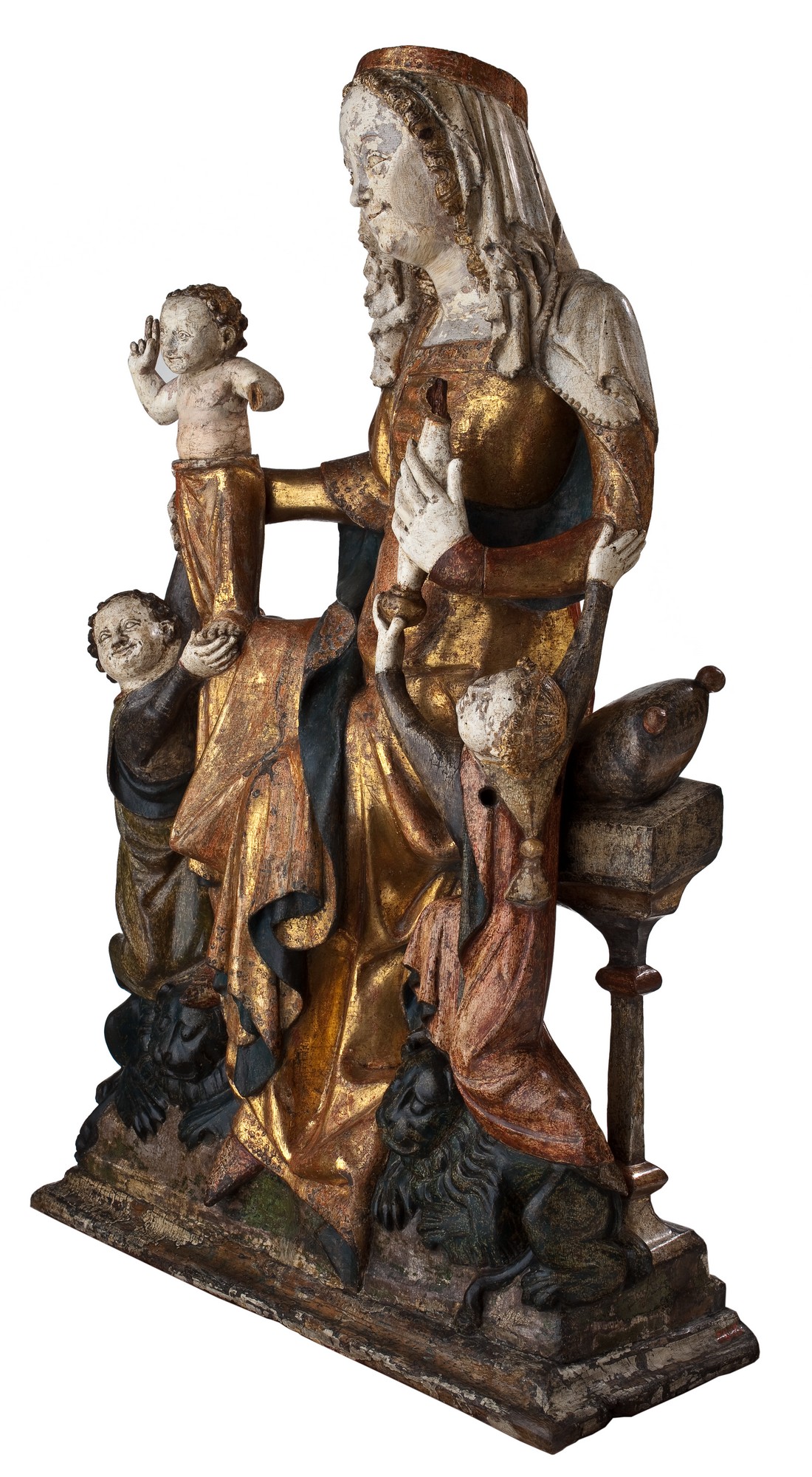
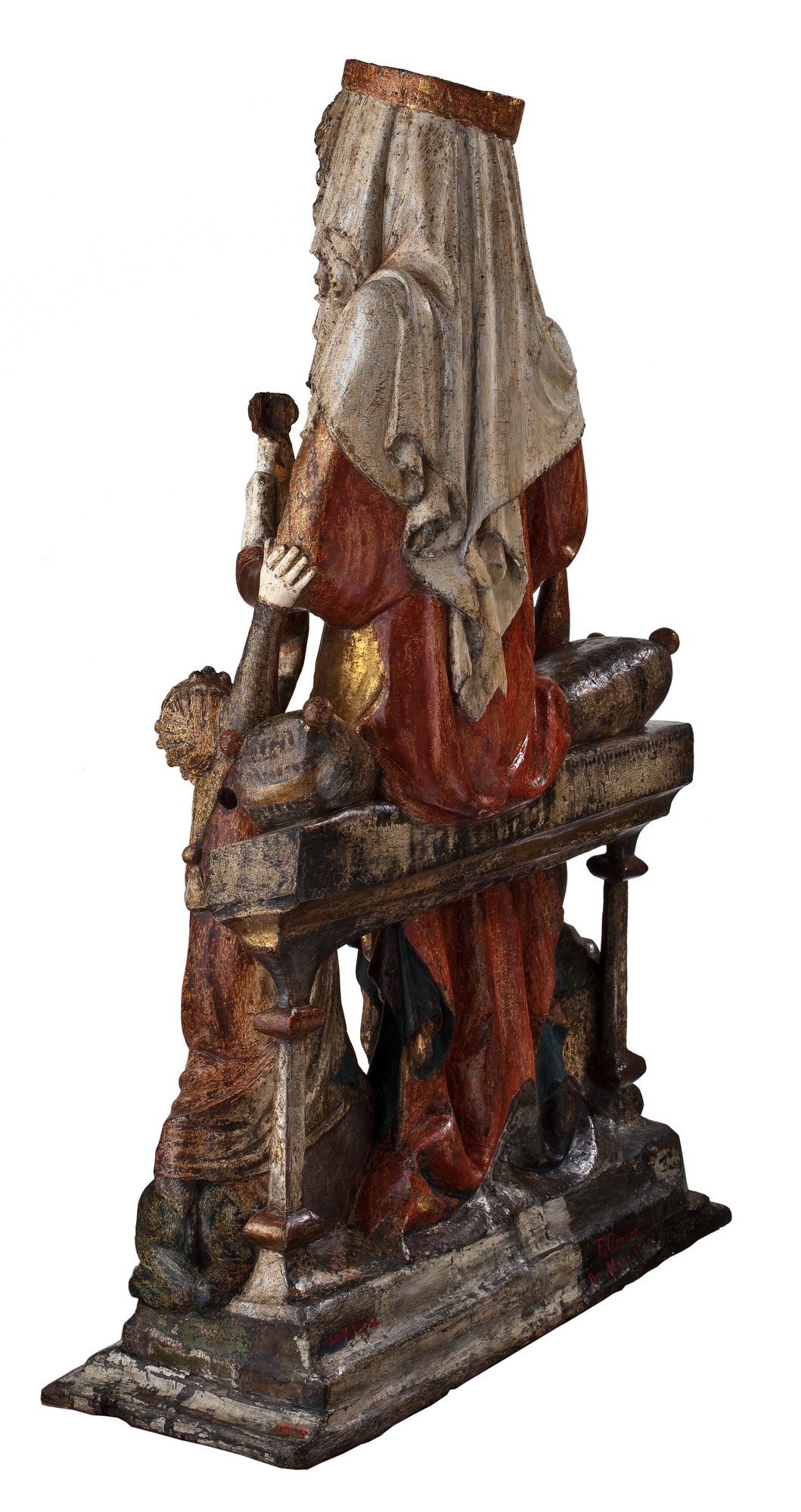
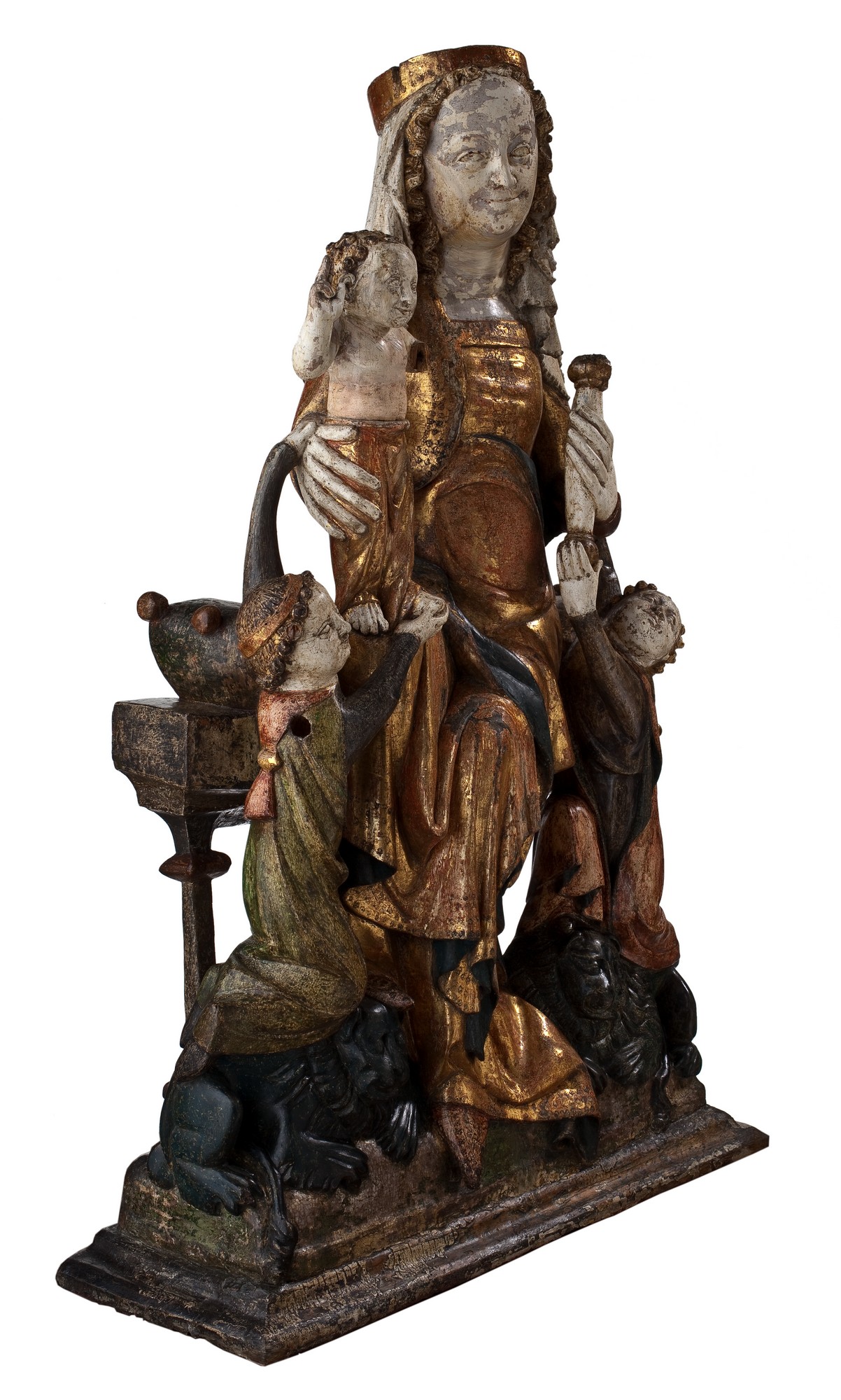
workshop: Workshop of the Master of Figures of the Apostles
date: 2nd third of 14th c.
place of creation: Silesia
object type: figural group
material: linden wood
technique: sculpting, polychromy, tempera, gilding, pulment gilding of silver, silvering
dimensions: H 98 x W 65 x D 24 cm
- before 1915 Skarbimierz (Brzeg County, Opole Voivodeship), former location
- ca 1915 Hoffmann, Paul (fl. ca. 1915) – resident of Breslau (Wrocław), Wrocław (Wrocław County; Lower Silesian Voivodeship), property
- 1915-1945 Silesian Museum of Crafts and Antiquities (Wrocław) / Schlesisches Museum für Kunstgewerbe und Altertümer (Breslau), Wrocław (Wrocław County; Lower Silesian Voivodeship), property
- Silesian painting and sculpture of the Middle Ages / Schlesische Malerei und Plastik des Mittelalters, Wrocław, 01.08.1926 - 30.10.1926
- Abramowski, Paul, Zur Ausbreitung des Löwenmadonnenkreises im Gebiet der Deutschordenslandes, "Schlesiens Vorzeit in Bild und Schrift. Zeitschrift des Schlesischen Altertumsvereins, Neue Folge: Jahrbuch des Schlesischen Museums für Kunstgewerbe und Altertümer", z. 10, 1933, s. 46, 49
- Bachmann, Hilde, Gotische Plastik in den Sudetenländern vor Peter Parler. Beiträge zur Geschichte der Kunst im Sudeten-Karpathenraum, t. 7, Brünn 1943, s. 63
- Bachmann, Hilde, Schlesien und die böhmische Plastik des 14. Jahrhunderts, "Zeitschrift für Ostforschung", z. 4, 1953, s. 522
- Białłowicz-Krygierowa, Zofia, Studia nad snycerstwem XIV wieku w Polsce, Warszawa – Poznań 1981, t.1, s. 37-42, 80, przyp. 4, s. 97-98
- Białłowicz-Krygierowa, Zofia, Ze studiów nad kręgiem Madonn na lwach. Motyw i system, [w:] Z dziejów sztuki śląskiej, red. Zygmunt Świechowski, Warszawa 1978, s. 247-252 i nn., il. 2-6
- Bloch, Peter, Die Muttergottes auf dem Löwen, "Jahrbuch der Berliner Museen", z. 2, r. 12, 1970, s. 261, 280, il. 31
- Braune, Heinz, Wiese, Erich, Schlesische Malerei und Plastik des Mittelalters. Kritischer Katalog der Ausstellung in Breslau 1926, Leipzig 1929, s. 13, poz. kat. 9, il. 6;
- Buchwald, Conrad, Einige Hauptwerke der kirchlichen Malerei und Bildhauerei des Mittelalters. Führer durch das Schlesisches Museum für Kunstgewerbe und Altertümer, Breslau 1925, s. 6-7
- Clasen, Karl Heinz, Die mittelalterliche Bildhauerkunst im Deutschordensland Preussen, Berlin 1939, s. 101, 102, il. 68
- Clasen, Karl Heinz, Die preussischen Werkstätten des Löwenmadonnenstiles und ihre Auswirkung auf die Nachbarräume, "Die Hohe Strasse. Schlesische Jahrbücher für deutsche Art und Kunst im Ostraum", z. 1, 1938, s. 97
- Dobrowolski, Tadeusz, Rzeźba i malarstwo gotyckie w województwie śląskim, Katowice 1937, s. 17
- Dobrowolski, Tadeusz, Sztuka na Śląsku, Katowice 1948, s. 105-106, il. 45
- Dutkiewicz, Józef Edward, Małopolska rzeźba średniowieczna 1300-1450, Kraków 1949, s. 58
- Dutkiewicz, Józef Edward, Rzeźba, [w:] Sztuka średniowieczna, red. Tadeusz Dobrowolski, t. 1, Kraków 1965, seria Historia sztuki polskiej, s. 302, il. 188
- Frey, Dagobert, Schlesiens Künstlerisches Antlitz, "Die Hohe Strasse. Schlesische Jahrbücher für deutsche Art und Kunst im Ostraum", z. 1, 1938, s. 26-27
- Guldan-Klamecka, Bożena, Tronująca Maria z Dzieciątkiem na lwach, [w:] Sztuka Śląska XII-XVI w. Skarby w Muzeum. Informator, red. Bożena Guldan-Klamecka, Wrocław 1997, s. 12, il. na s. 13
- Guldan-Klamecka, Bożena, Trůnící Madona s Dítetem stojící na lvech ze Skarbimierze / Madonna auf dem Löwenthron von Hermsdorf, [w:] Gotické madony na lvu / Gotische Löwenmadonnen. Splendor et Virtus- Reginae Coeli, [kat. wyst., Muzeum umění Olomouc we współpracy z Bergbau- und Gotikmuseum Leogang, 13 II -11 V 2014 i 5 VI-31 VIII 2014], red. Ivo Hlobil, Jana Hrbáčová , Olomouc 2014, s. 126-128
- Guldan-Klamecka, Bożena, Ziomecka, Anna, Sztuka na Śląsku XII-XVI w. Katalog zbiorów, Wrocław 2003, seria Katalogi zbiorów Muzeum Narodowego we Wrocławiu, s. 203-204
- Kaczmarek, Romuald, O proweniencji trzech najważniejszych śląskich rzeźb Madonn na lwach, "Roczniki Sztuki Śląskiej ", z. XXIV, r. 2015, Wrocław 2015, s. 9-25
- Kębłowski, Janusz, Dzieje sztuki polskiej. Panorama zjawisk od zarania do współczesności, Warszawa 1987, s. 71, il. 162
- Kębłowski, Janusz, Polska sztuka gotycka, Warszawa 1976, s. 24
- Le Goff, Jacques, Kultura średniowiecznej Europy, Warszawa 1970, s. 453, il. 221
- Metz, Peter, Die Muttergottes über Löwen aus Hermsdorf, "Schlesien. Eine Vierteljahresschrift für Kunst, Wissenschaft und Volkstum", z. 4, r. 6, 1961, s. 193-199, il. 3
- Suckale, Robert, Die "Löwenmadonna", ein politischer Bildtyp aus der Frühzeit Karl IV.?, [w:] Das mittelalterliche Bild als Zeitzeuge: Sechs Studien, red. Robert Suckale , Berlin 2002, s. 172, 177, 181
- Zygmunt Świechowski, Osteuropäische Architektur und Plastik, [w:] Das Mittelalter II. Das Hohe Mittelalter, red. Otto von Simson, t. 6, cz. 2, Berlin 1972, seria Propyläen Kunstgeschichte, s. 289, 296, nr 305b
- Walicki, Michał, Ze studiów nad plastyką XIV wieku w Polsce, "Biuletyn Historii Sztuki i Kultury", z. 9, r. 2, 1933-1934, il. 6
- Wiese, Erich, Schlesische Plastik vom Beginn des XIV. bis zur Mitte des XV. Jahrhunderts, Leipzig 1923, s. 21-26, 74, tab. IV
- Wojturski, Grzegorz, Sztuka Śląska XII-XVI w. Muzeum Narodowe we Wrocławiu. Przewodnik., Wrocław 2012, s. 22, il. s. 23
- Ziomecka, Anna, Rola Wrocławia w kształtowaniu drewnianej rzeźby na Górnym Śląsku w XIV i XV wieku, [w:] Między Wrocławiem a Krakowem. Sztuka gotycka na Górnym Śląsku, red. Olga Nowak, Katowice 1995, s. 10
- Ziomecka, Anna, Śląska rzeźba gotycka. Katalog zbiorów., Wrocław 1968, s. 37-41, poz. kat. 6
- Ziomecka, Anna, Thronende Muttergottes auf dem Löwen aus Skarbimierz, [w:] Die Parler und der Schöne Stil 1350-1400. Europäische Kunst unter den Luxemburgern. Ein Handbuch zur Ausstellung des Schnütgen-Museums in der Kunsthalle Köln, red. Anton Legner, t. 2, Köln 1978, s. 493-494
provenance: 1948, transfer
National Museum in Wrocław Gallery of Art 12th–15th c.
inventory number: MNWr XI-121