Lejman, Beata, Malarstwo Europy Środkowej XVI-XVIII w. Niemcy, Austria, Czechy, Węgry, Słowacja. Katalog zbiorów., Wrocław 2012, seria Katalogi Zbiorów Muzeum Narodowego we Wrocławiu, kat. 62, il.
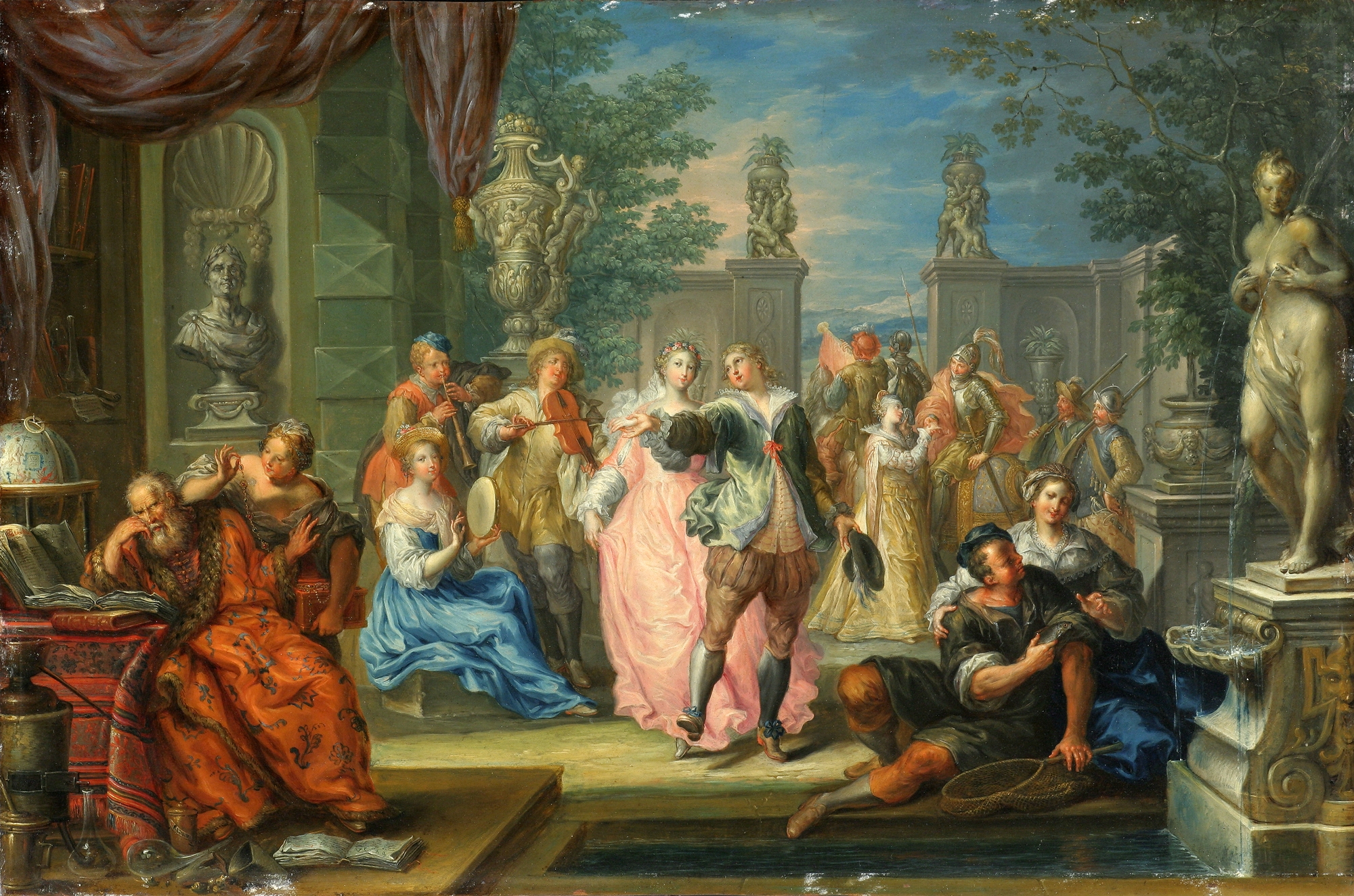
Out of a few dozen paintings by Platzer which existed in pre-war Wrocław, only two remain in the National Museum: the described here Allegory of Music and the Four Temperaments, and the similarly dated Allegory of the Art of Sculpture, both from the collection of Albrecht Sebisch, probably a host of the artist, as well as his friend, during Platzer’s stay in the then Breslau. Among the admirers of the artist’s work there were also members of the royalty (e.g. William VIII bought his paintings for his Kassel residence before 1749), and writers, such as C.L. Hagedorn, who praised the artist in his work Lettre a un Amat. De la Peint dated 1755 (p. 310, etc.). The popularity of the paintings of consistently high quality which he created over a period of thirty years is confirmed by the topography of their presence – from Moscow and St. Petersburg, London, Bergen and Stockholm, to New York and Sydney (cf. G. Agath, Johann Georg Platzer. Ein Gesellschaftsmaler des Wiener Rococo, Dresden 1955). In the 18th century, his fine pictures, with their enamel-like finish and compositions pleasing to the eye of the connoisseur, enjoyed great success among the wealthy upper classes and admirers of the paintings of the so-called Dutch 'Little Masters'. The latter provided the roots of Plazer's work, among the geselschapje of David Vinckboons and Willem Buytewech the Elder, the images of Antwerp artists’ studios and Kunstkabinets by Jan Brueghel the Elder, David Teniers the Younger, the Francken family, Simon de Vos, Hieronymus Janssens, Gerard Thomas, Balthasar van den Bossche, and also the Leiden fijnschilders of Gerard Dou, the Mieris and the Werffs. Plazer's elegant and luminous compositions were also influenced by the art created at the French royal court (Caspar Netscher, Boucher, perhaps also Watteau, Lancret, de Troy), which in the 18th century dictated the trends for the whole of Europe. Italian artists can be also indicated as a source of inspiration for the painter, in particular the Galli-Bibien family residing in Vienna. The characteristically bright and extensive colour palette using sophisticated hues (bluish lilacs, lemony yellows, luminous sea greens, rich purples, pinks and silvery greys) is in line the Rococo style which also delves into the aesthetics of Mannerism: the porcelain-smooth, Rudolphine school paintings dating from around 1600.
In the catalogue of the gallery of the House of Silesian States (Das Ständehaus in Breslau), the painting had a title Die Tonkunst, and only when it arrived in the Silesian Museum of Fine Arts was renamed Allegory of Four Temperaments. The picture shows four groups of figures in a garden in front of the gate showing a view of the mountainous landscape opening up behind it. In the foreground, to the left, an old man in a colourful coat trimmed with fur pores thoughtfully over a book, his hand fending off a young woman – he chooses science over her charms and wealth, confirmed by the objects which surround him – he is probably a melancholic. Across from him, a phlegmatic peasant with a fishing net sits close to the fountain, passing to his female companion the fish he caught. In the centre, one can see a sophisticated sanguine personage, enjoying a courtier’s lifestyle, who leads a lady in a dance, accompanied by music, while in the background, at the gate, a knight embodying a choleric temperament, says goodbye to his sweetheart to rejoin other soldiers.
[Beata Lejman]
This website uses cookies so that our service can work better. For more information and to personalise your preferences, click ‘Settings’. You can change your preferences at any time and you can also withdraw your consent to the use of cookies on the site below.
By sliding the toggle to the right, you activate a specific consent. By sliding the toggle to the left, you deactivate that consent.
Necessary (2)
Name
Supplier
Objective
Expiry date
Type
Name:
cookie Consent
Supplier:
National Museum in Wrocław
Objective:
Stores information about the user's cookie preferences, consent or refusal.
Expiry date:
6 months
Type:
HTTP
Name:
PHPSESSID
Supplier:
National Museum in Wrocław
Objective:
The PHPSESSID file is a PHP native file and allows sites to remember session state data. On the Site, it is used to establish a user session and transmit state data using temporary cookies commonly known as session cookies. As the PHPSESSID cookie has no set expiry date, it disappears when the browser is closed.
Expiry date:
Closing the browser
Type:
Technical cookie
Statistics (4)
Name
Supplier
Objective
Expiry date
Type
Name:
_ga
Supplier:
National Museum in Wrocław
Objective:
Registers a unique identifier which is used to generate statistical data about how the visitor uses the site.
Expiry date:
2 years
Type:
HTTP
Name:
_gid
Supplier:
National Museum in Wrocław
Objective:
It is used to store information about how visitors use the website and helps to create an analytical report on how the website is performing.
Expiry date:
1 day
Type:
HTTP
Name:
_ga_GJZ5NZ7YE3
Supplier:
National Museum in Wrocław
Objective:
Used to distinguish between individual users during their visits to the site. It stores a unique user identifier, which allows Google Analytics to track repeat visits and analyse how users use the site over time. This helps to better optimise the content and functionality of the site.
Expiry date:
2 years
Type:
HTTP
Name:
_ga_59B58CLBBD
Supplier:
National Museum in Wrocław
Objective:
Used to store and track data about user activity within a specific session. Enables analysis of user traffic on the site in Google Analytics to help administrators understand how users are interacting with the site. It is part of Google Analytics 4 and allows user sessions to be measured at a sub-domain level.
Expiry date:
2 years
Type:
HTTP
Functional (2)
Name
Supplier
Objective
Expiry date
Type
Name:
contrast
Supplier:
National Museum in Wrocław
Objective:
Stores information about the user's preference for high contrast mode on the website. Its purpose is to adjust the colour scheme of the site to increase the readability of content for people with visual problems or users who prefer higher visual contrast.
Expiry date:
7 days
Type:
Functional cookie
Name:
textsizestyle
Supplier:
National Museum in Wrocław
Objective:
It stores information about a user's preferences for font size on a website. Its main purpose is to adapt and maintain the selected text size (e.g. enlarged or reduced) on subsequent visits to the website, thus improving accessibility and user comfort, especially for people with poorer eyesight.