Przejdź do treści

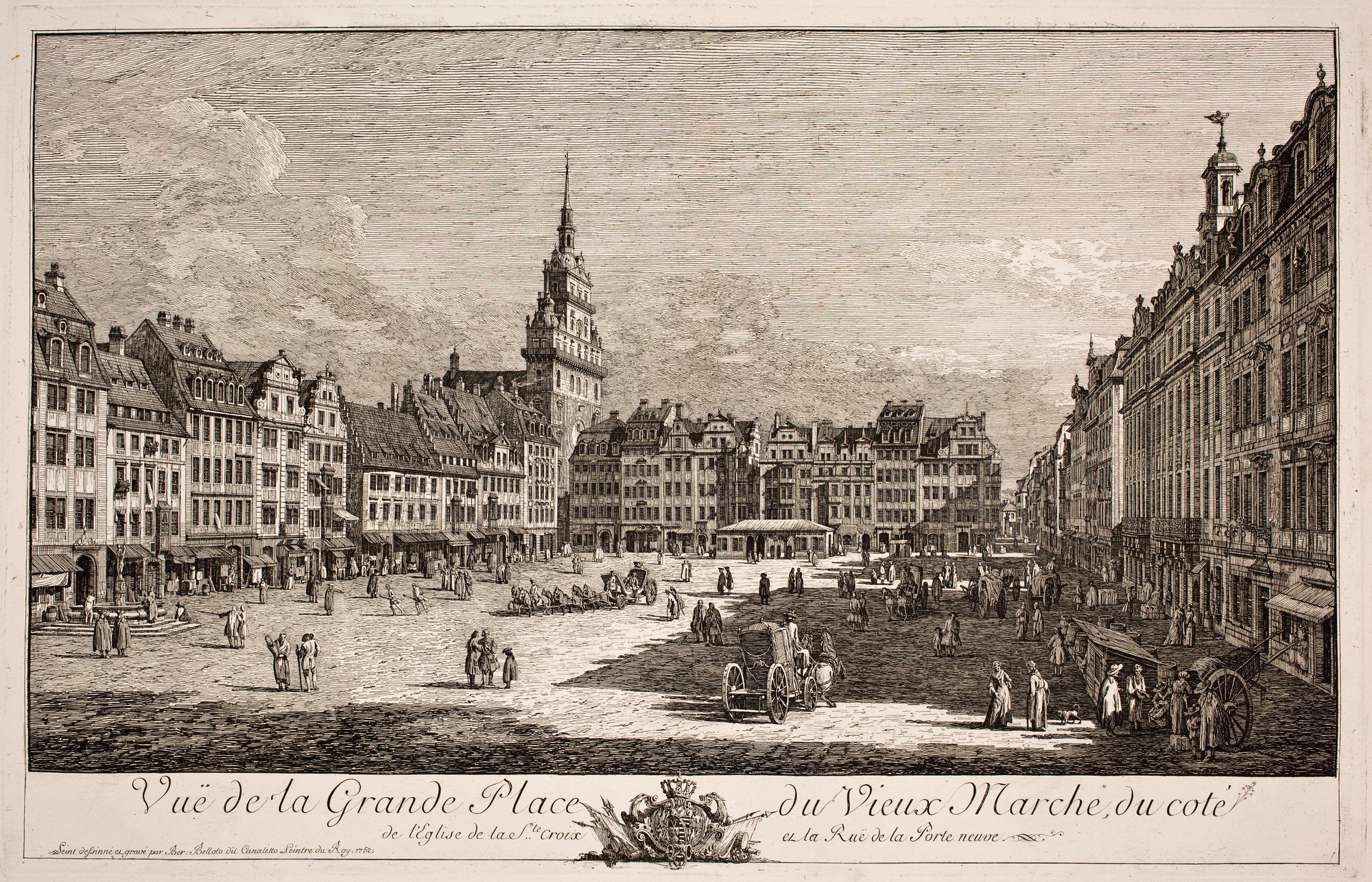
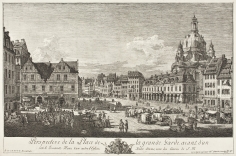
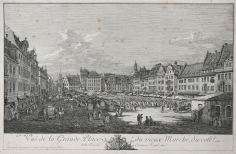
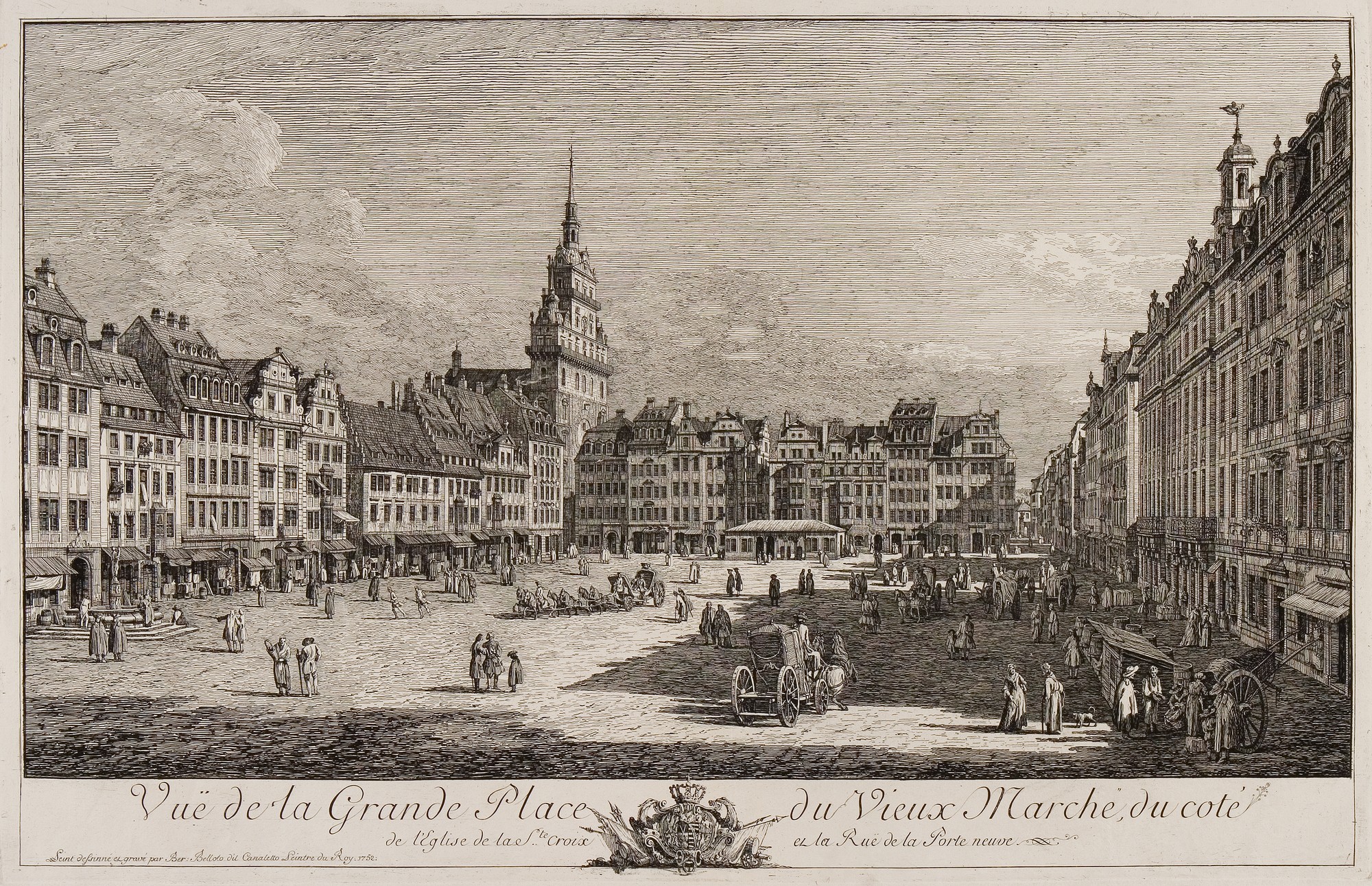
Dresden Old Town Square from the Schloßgasse

author of the engraving: Bellotto, Bernardo (1721-1780)

author of the original: Bellotto, Bernardo (1721-1780)

date: 1752

place of creation: Dresden (Germany)

object type: print

material: paper

technique: etching

dimensions: plate imprint H 542 x 840 mm, sheet 754 x 1015

signature:
left bottom corner: Peint desinné et gravé par Ber: Belloto dit Canaletto Peintre du Roy: 1752:
inscription:
[inscription divided by the coat of arms]: Vuë de la Grande Place du Vieux Marchë, du coté / de l’Eglise de la S..te Croix et la Ruë de la Porte neuve.
  • Allgemeines Künstler-Lexikon. Die bildenden Künstler aller Zeiten und Völker, München / Leipzig 1997, s. 95 (cykl)
  • Andresen, Andreas, Wessely, Joseph Eduard, Handbuch für Kupferstichsammler oder Lexikon der Kupferstecher, Maler, Radirer und Formschneider aller Länder und Schulen nach Massgabe ihrer geschaetztesten Blaetter u. Werke, t. 1-2, Leipzig 1870-1873, t. 1, s. 255, poz. 2 (cykl)
  • Bernardo Bellotto. W 300. rocznicę urodzin malarza, red. Magdalena Królikiewicz, Artur Badach, Warszawa 2022, kat. nr 31, s. 190-192
  • Fritsche, Hellmuth Allwill, Bernardo Belotto genannt Canaletto, Burg 1936, s. 145, poz. VR 17
  • Heinecken, Karl Heinrich von, Dictionnaire des artistes, dont nous avons des estampes, t. 2, Leipzig 1788, seria Contentant la lettre B–Biz, s. 435, poz. 10
  • Heinz, Günther, Verzeichnis der Radierungen, [w:] Bernardo Bellotto genannt Canaletto. Ausstellung unter der Leitung von: Staatliche Kunstsammlung Dresden, Nationalmuseum Warschau, Kunsthistorisches Museum Wien, Wien 1965, s. 91, poz. 169
  • Le Blanc, Charles, Manuel de l'amateur d'estampes, t. 1-4, Paris 1854-1890, t. 1, s. 264, poz. 11
  • Manikowska, Ewa, Bernardo Bellotto i jego drezdeński apartament. O tożsamości społecznej i artystycznej weneckiego wedutysty, Warszawa 2014, s. 251-256 (cykl)
  • Meyer, Rudolph, Die beiden Canaletto – Antonio Canale und Bernardo Belotto, Dresden 1878, s. 48-49, poz. 17
  • Nagler, Georg Kaspar, Neues allgemeines Künstler-Lexicon oder Nachrichten von dem Leben und den Werken der Maler, Bildhauer, Baumeister, Kupferstecher etc., t. 1-22, München 1835-1852, t. 1, s. 395 (cykl)
  • Allgemeines Lexikon der bildenden Künstler von der Antike bis zur Gegenwart, red. Ulrich Thieme, Felix Becker, t. V, Leipzig 1911, s. 489 (cykl)
  • Vesme, Alexandre de, Le Peintre-graveur Italien. Ouvrage Faisant Suite au Peintre-graveur de Bartsch, Milan 1906, s. 498 (cykl)
  • Żak, Izabela, Dawna grafika włoska, t. 1-2, Wrocław 2017, s. 78, poz. 110
not on display

National Museum in Wrocław Department of Prints 16th–19th c.

inventory number: MNWr VII-2159
copyrights to object: PUBLIC DOMAIN
Download

Old Market Square (Altmarkt) viewed from Schloßgasse is surrounded by buildings, with an alternating arrangement of gable- and ridge-fronted townhouses, and overlooked by the tower of the Kreuzkirche (Holy Cross Church) rising high above the rooftops. The oldest church within the city’s walls was first mentioned in the late eleventh-early twelfth century and was then dedicated to St Nicholas. It was renamed the Kreuzkirche in 1388, the new dedication honouring the precious relic, a splinter of wood from the Holy Cross, presented to the church in 1234, and connected to the structure’s remodeling in the Gothic style. After the Reformation, the Kreuzkirche became the city’s principal Protestant church. In 1760, during the Seven Years War, the church was shelled by the Prussian artillery and collapsed, as Bellotto documented in the painting Dresden. Ruins of the Kreuzkirche and print based on it. The church was rebuilt in 1764-1782, and the tower shown by Bellotto would be considerably altered (there were plans for preserving the old tower that had survived the shelling, but it eventually collapsed). In the centre of the composition, right to the church, there is a pavilion called Chaisenhaus: it was erected in 1746 as a municipal sedan chairs “garage". On 26 September 1868, a humorous postcard was issued to celebrate its one hundred-twenty-third anniversary: it can still be found at art auctions. Like Bellotto’s work, it documents the building that was demolished in 1878 following the introduction of the horsecar. Close to the composition’s left edge is the Fountain of Justice, removed in 1888. Like in other vedute from The Views of Dresden series, Bellotto introduces scenes from the city’s busy life and traffic: characters from different social strata and variety of carriages, coaches, and carts.

The featured prints was based on Bellotto’s painting Dresden: Altmarkt from Schloßgasse. It is complemented by a pendant composition: Dresden: Altmarkt from Seegasse. The exact rendering of even minute architectural details and precision in the treatment of perspective and foreshortenings in the depiction of the densely built-up area clearly indicate that the painter probably used a camera obscura. The composition features striking contrasts of shadow cast by the tall buildings surrounding the square and areas bathed in sunlight.

State II/III

keywords: Baroque  |  Bibliothek der Königliche Akademie der Künste, Berlin (institution)  |  Dresden (Germany)  |  fountain  |  German graphics  |  Italian graphics  |  church (architecture)  |  town  |  pavilion (architecture)  |  market square  |  German art  |  veduta

Related objects (12):

PL | EN

Privacy Settings (cookies)

This website uses cookies so that our service can work better. For more information and to personalise your preferences, click ‘Settings’. You can change your preferences at any time and you can also withdraw your consent to the use of cookies on the site below.
Privacy policy (the link will open in a new window)
*with the exception of technical cookies
By sliding the toggle to the right, you activate a specific consent. By sliding the toggle to the left, you deactivate that consent.